
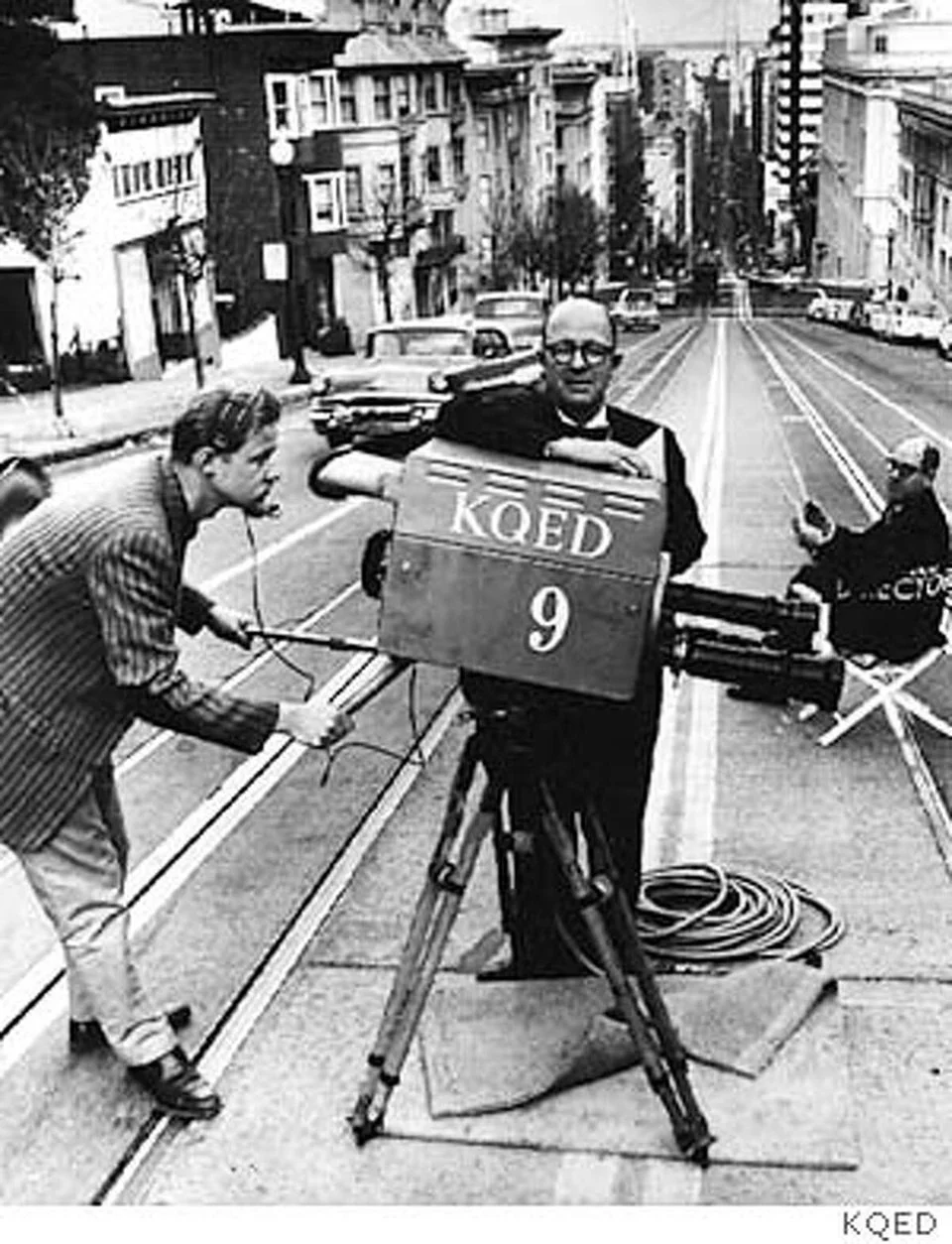
KQED has been a cherished resource in the Bay Area since James Day and Jonathan Rice created the station on June 1, 1953, with the new station signing on, live on-air, on April 5, 1954.
I was honored to work a few feet from Jonathan Rice’s office during my years in KQED Television Programming. The vision, dedication and drive of James Day and Jonathan Rice to produce award-winning, locally relevant and entertaining KQED programming, remained a significant force at the station until Rice’s retirement in 1996.
Goals
The essays on this site present my personal views about the value of KQED’s history, plus my concerns about KQED’s operations, content delivery and financial decisions in recent years. It in no way seeks to criticize KQED, a station which I have enjoyed and valued for many years.
My goal is to return KQED to its former role as an inhouse on-air television and radio production powerhouse reflecting its origins, its 1950’s-1960’s history, plus my own experience at KQED during its similarly robust live on-air and local inhouse television and radio production era in the 1980’s and 1990’s.
My fervent hope is that someday soon, I can rewrite this entire website to celebrate many new Bay Area-focused on-air radio and television programs all produced inhouse by KQED television and radio production staff, and by KQED journalist staff.
I also want to see KQED Board expansion to include one Board seat (each) elected from: KQED members, KQED unaffiliated staff, KQED NABET-CWA 51 staff, KQED SAG-AFTRA Northern California staff, KQED NATAS members, and KQED SPJ staff members. These additional Board positions would significantly expand the number of KQED Board seats.
New Board members from production and content professional staff could successfully redirect KQED’s operations and leadership to an emphasis on live, on-air fundraising for production of more inhouse, on-air broadcast radio and television production. Producing significantly more local, Bay Area-centered and personally-engaging new KQED on-air programming, seems appropriate for an FCC dual-licensed PBS and NPR affiliate like KQED, moving the station forward beyond the station’s current dependence on airing generic PBS and NPR rebroadcasts.
We want to see our beautiful region, our unique bay area cultures, our history and our Bay Area visionaries, in new programming produced by KQED staff and broadcast on-air.
To achieve many of these changes, members must reclaim the right to vote on all KQED Board member elections and Board actions. KQED Board members once claimed member voting was too expensive, however, there are many methods of voting now which do not require mailing paper ballots, which still could be mailed to those who request them. As stated elsewhere on this website, only 15% of KQED members voted in the election which removed members’ right to vote on KQED Board and leadership, yet members, donors, grants and bequests now fund 100% of KQED operations.
Likewise, I want to see all KQED CAP members elected by KQED members, with those new CAP members attending all KQED Board meetings, voting on all KQED Board actions and holding KQED Board seats.
Finally, I hope to see a new, open KQED Board and CAP process, accessible via both ZOOM and on-air, which encourages KQED members, donors and staff to attend all KQED Board and CAP meetings, and to have the ability to pose comments and questions. It’s ironic that KQED CAP meetings, whose purpose is to advise the KQED Board and leadership on KQED broadcast community interests and issues, has allegedly not been accessible to the communities being represented. I discuss all of the above concepts in-depth elsewhere on this website.
Are these changes possible? Yes. Since donors, grant makers and members now allegedly fund 100% of all KQED operations, donors, grant makers and members have the right to request that these needed improvements be implemented at KQED.
History
To read more about KQED’s first twenty years, its most prolific inhouse and on location, staff produced, local television era, please read this excellent Current article by David Stewart, posted online, February 3, 1997. “KQED Made its Mark by Making Programs.” Mr. Stewart states:
“KQED was exceptionally industrious in its first two decades. But it did much more than turn out an astonishing number of programs. In the 1950s and ’60s its productions were defining what educational television was and what public TV would become. As James Day has written, “. . . if what we invented bore very little resemblance to . . . the commercial networks, the difference was entirely deliberate.”
I believe that CEO Michael Islip, the current KQED Board and Community Advisory Panel (CAP) Members, plus former CEO John Boland are all very good people, who like me, want to see KQED thrive and prosper during these troubled financial times at the Bay Area’s largest, dual FCC licensed PBS/NPR station.
Campaign 21 And The Multiplatform Transition
In my opinion, as someone who worked with the KQED Television Programming Department budget during Jim Scalem and Nat Katzman’s era, when Jonathan Rice still had an office in the KQED TV Programming division, I believe that the switch to a multiplatform operation (blogging, podcasting and inhouse events), plus the $94 million invested in a Campaign 21 building remodel to house new, multiplatform employee units which increased KQED staff and management payroll to 499 employees, many of whom were not engaged in local production of broadcast television programming, made KQED too content diversified, too delivery siloed, too impersonal on air, less financially viable, and worse, less engaging to donors, viewers and listeners, who no longer saw themselves or their communities on-air, since their donations were no longer being invested in KQED’s historic strength, producing local television and radio programming inhouse using KQED production staff.
InsideRadio quotes Michael Islip, who allegedly made the statements below in the December 7, 2021 article: “KQED Completes $94 million Renovation of San Francisco HQ.”
“Campaign 21 has accelerated growth in our programming, services and staff in ways we never could have done otherwise,” Isip added. “These strategic investments make KQED a model for responsible and responsive independent local media and ensure that generations of Bay Area residents can count on KQED to provide trusted information and news, high-quality programming and education tools and live experiences.”
Inhouse Local Television Production
The accelerated growth in our programming” seems to have failed KQED television viewers who may have believed they were being promised more KQED inhouse local television program production with their Campaign 21 dollars. (Allegedly, both KQED television and radio production staff, plus some KQED FM staff journalists were let go starting in 2020, despite Campaign 21 fundraising.)
Local On-Air Pledge Breaks
I support blogging and podcasting at KQED, however, I also support a return to a significant number of 30 to 60-minute inhouse, staff-produced local television and radio programs about the Bay Area region. I would also like to see local residents and celebrities hosting televised, live inhouse KQED Pledge Breaks, to more personally engage KQED with communities and potential donors in our region.
Board Accessibility
I feel that KQED was once more community engaging and socio-economically unifying within its entire Bay Area broadcast signal area, when Jonathan Rice was still connected with the station. As stated elsewhere on this site, KQED Board members were regular faces in the halls of KQED. They knew staff members, were interested in supporting locally produced programming and actively fundraised and advocated for inhouse broadcast television production. Those Board members were elected by KQED members, when members still had a voice in the decisions made by the KQED Board and management.
Member Voting Rights
In October 27, 2006, SFGate reported that KQED members gave up their voting rights, although allegedly only 15% of the station’s estimated 190,000 members voted in that election. The election results gave the KQED Board full control over the station, with the Board now appointing future Board members and Community Advisory Panel representatives. In an explanation for the Board’s 1998 decision to provide the members this option, an October 5, 2006 Current article, “KQED Asks Members to Give Up The Vote,” stated:
“This is about money and this is about responsiveness,” Board Chair Nick Donatiello told the San Francisco Chronicle. “It’s up to the members if they want to spend this money on elections. It could buy a lot of programming.”
Mr. Donatiello was well intentioned, yet it appears to me that locally produced television and radio programming under the now self-perpetuating Board, has been significantly reduced since that 2006 move to eliminate member voting.
2025 San Francisco Board of Supervisors Resolution
Allegedly, KQED now produces only 6.5 hours of local television annually, having eliminated its entire professional Television production division, as stated in the July 8, 2025 San Francisco Board of Supervisors Resolution File Number 250726, Enactment Number 031625:
“WHEREAS, For decades, KQED has been a vital platform for San Francisco Bay Area voices, telling stories that are relevant to local communities, reflecting the region's diversity, and engaging meaningfully with the communities across the Bay Area; and
WHEREAS, In 2023, KQED, as a major public broadcaster, has already eliminated all local news programming despite the station's historical expression of the mission to serve the public; and
WHEREAS, Currently, KQED is only maintaining 6.5 hours of new local television content per year, leaving "Check Please! Bay Area" as the last remaining locally produced television show; and
WHEREAS, Without local production, KQED is failing its core mission of public service and responsibility to air programming that can respond quickly to shifting needs and interest of communities; and… (Continued)
[Be it] … FURTHER RESOLVED, That the Board of Supervisors of the City and County of San Francisco urges KQED to reinvest in original, community-rooted storytelling that is produced by local staff who cares deeply about public service; and, be it… (Continued)
FURTHER RESOLVED, That the Board of Supervisors hereby directs the Clerk of the Board to transmit a copy of this Resolution to Jason Black, Executive in Charge, Content Operations at KQED.”
(KQED produces a website, station ID’s, fillers between programs, podcasts, radio segments and blogs, which are not included in the alleged annual 6.5 hour KQED television production figure.)
Bay Area Produced Content Versus PBS System Content
KQED’s array of purchased television content and generic, PBS produced Pledge Breaks, in my opinion, seem impersonal, no longer reflecting the Bay Area’s unique individuals, institutions, energy or creativity.
In contrast, I feel that the quality of KQED’s past, locally produced broadcast television programming, plus its Bay Area-centric and local celebrity-staffed Pledge Breaks, Auctions and local educational and entertainment programming, effectively personalized the station, connecting viewers and listeners to on-air talent and staff members whom they recognized and enjoyed for decades, many years after James Day and Jonathan Rice first created those successful on-air local programs and fundraising vehicles.
Founders James Day And Jonathan Rice
The multiplatform content transition, which seems to have eliminated significant television and radio inhouse program production, radio and television production staff, plus allied support staff, in my opinion, was not the outcome intended by Jonathan Rice and James Day when they created KQED.
KQED Member Feedback
The KQED Board and management need to once again hear the voice of Bay Area members and donors. Members have a right to vote on filling all board and CAP positions, plus approving or rejecting all Board, CAP and management decisions. Members deserve to have direct email links to each Board and CAP member placed on the KQED website, so members and staff can express their views, since Bay Area members now provide full financial support for all KQED operations.
Local Broadcast Production Content Reflects Our Region
KQED members deserve more on-air local television and radio content created inhouse by KQED staff, plus more on-air broadcast programming produced inhouse by KQED staff, all of which should reflect our geographic region, our Bay Area visionaries and our KQED broadcast communities.
My hope is that other viewers will use the KQED Contact Support online form, using the Topic: “Office of the President”, to ask KQED management to rehire journalists, rehire radio and television production staff, and increase inhouse Bay Area-focused television production. In my opinion, KQED should be asked to produce and broadcast a minimum of 30 hours of entertainment and educational, 30 and 60-minute radio and television programming inhouse, each month.
KQED Funding
Since KQED is now completely self-supporting, KQED leadership and operations, and use of our dollars, should reflect the wishes of the members and donors who now fund all KQED operations.

As John Boland, former CEO of KQED stated in an April 15, 2001 SFGate article, “Channeling Big Money” by Dan Frost, “Everybody has a TV, no matter how poor they are.” I agree. I would also add that even the poorest among us can afford a simple, antenna-based radio as well.
Multiplatform Content
Blogging and podcasts are important, yet they should not replace local television and radio production, or on-air broadcast of unique Bay Area information and entertainment programming.
Equitable Distribution Of Broadcast Content
More importantly, locally produced and broadcast radio and television programming does not discriminate between Bay Area audience members and donors.
On-air broadcast of local content is not regionally or economically exclusive or discriminatory.
On-air television broadcast of local content is not physically or financially inaccessible for some members, as are ticketed KQED inhouse and Bay Area events, which are often expensive and one or more hours from member’s homes.
On-air broadcast of local content is not digitally exclusive, as are podcasts, websites and blogs, which serve only those who can afford internet and cell service.
Limited Distribution Of Online Only Content
I feel KQED should provide monthly paper copies of all blog posts and website articles it produces, for those members who request that service. Some members may have no other means of access to that unique online material, created using their member dollars.
I believe that a nonprofit, dual FCC licensed station like KQED should have all content and events it produces, promotes and hosts, broadcast on-air to KQED television viewers, as John Boland suggested in 2001. Increasing inhouse, locally-produced, on-air broadcast radio and television programming at KQED, would do just that.
Unifying The Bay Area
Bay Area focused, inhouse produced television and radio on-air broadcasts at KQED were once the great equalizers, uniting the entire Bay Area region together in one shared experience.
Let’s ask KQED to distribute all content it creates on-air, plus blog posts provided in print, so all members receive equal access to KQED content.

When I worked at KQED the Board members were frequent faces around the station. They greeted staff, visited our departments and were very hands-on, volunteering during KQED Pledge Drives and events. During those years, KQED members could vote on the Board member whom they felt best served the interests of the station and it’s future. There was ample member to Board and Board to member communication.
Self-Perpetuating Board
Today, after the 2006 KQED vote to eliminate member voting rights, KQED has a highly capable and accomplished self-perpetuating Board of Directors, yet has only one Board member who is experienced in broadcasting. That Board member allegedly expressed an interesting perspective in an All Things Digital, December 13, 2012 online article entitled, “What Makes Video ‘professional?’”.
Definition of “Professional” Radio And Video Production
Based on my years of experience with the highly trained and capable NABET-CWA Local 51 and SAG-AFTRA Northern California broadcast production professionals at KQED during Jonathan Rice’s tenure at the station, I appreciate some of the Board member’s alleged comments, yet believe some additional criteria must be met to be considered a true broadcast professional.
Like me, many KQED staff members, KQED journalists, and KQED radio and television production professionals, earned Bachelor’s degrees in journalism, ethical content, in broadcast communications, and in allied technical and engineering fields, with some earning Master’s degrees in their profession. In addition, some journalists like my colleague, Keven Guillory, completed John S. Knight Fellowships in Journalism at Stanford University, since they were viewed as leaders in their profession.
Professionalism in broadcasting most often requires focused, professional higher education and on-site training, plus active mentoring by those employed in the field, and in most cases, broadcasting internships or apprenticeships in the trades. Many of us attended professional seminars and workshops to enhance and update our skills.
“Vertical Video” Versus Professional Broadcast Production
Making the leap from hobbyist “vertical video” (on cell phones) to actual professional video broadcast production, in my opinion, requires advanced technical and studio editing training.
Several Bay Area college campuses and associations provide professional film and video production training, including Berkeley City College, Ohlone College, City College of San Francisco, Diablo Valley Junior College, St. Mary’s College of California, Santa Clara University, De Anza College, West Valley Community College, Silicon Valley Career Technical Education, California College of the Arts and the University of Silicon Valley, to name a few. Many of these institutions offer video production courses under the broader term, “Media Studies”. One of the many benefits of enrolling in an academic or apprentice Video training program are opportunities to connected with those already in the field, plus participating in media internships offered by broadcasters, through educational institutions. Often media internships lead to employment.
Confirming Reliable Sources
Aa a librarian with a Master’s degree in Information Science, I place an emphasis on locating and citing reliable sources, based on my professional training.
During my years at KQED our professional journalists, announcers and radio and television production staff, embraced those content values as well.
Professional training through higher education, mentorship and internships, prepares new content creators with the ability to sift through and locate reliable information. That skill has become incredibly important today, as condensed, top of the fold, A.I. search result summaries often lack citations or direct quotes from sources, nor the source of the A.I. statements. Likewise, monetized sites have additional goals which allegedly may not be allied with providing the most factual information available from reliable experts.
Professional Journalism Training
Several academic institutions and organizations in the Bay who are noted for exceptional Journalism training in discernment of factual and reliable sources. The University of California, Berkeley School of Journalism plus their UCB Graduate School of Journalism, the Stanford University Journalism Program which offers Journalism Fellowships, plus Journalism tracks at San Francisco State University, City College of San Francisco, De Anza College, San Francisco State University, and adult learning courses at KALW, offer a range of valuable classroom and hands-on training.
Professional Content Evaluation
Unfortunately, without professional training in evaluating content reliability from “experts”, bricks and mortar sources, or content found on the web, content creators may inadvertently make inaccurate statements or present unreliable information to audiences. I believe our accomplished KQED Board may embrace the same concerns for broadcasting professionalism, accuracy and integrity as I do, in their leadership role at KQED.
KQED Community Advisory Panel
KQED has a collaborative Community Advisory Panel (CAP) who advise the Board allegedly only once a year, on areas of interest to their respective regions. However, it seems that allegedly, CAP members may not vote in nor regularly attend KQED Board meetings. According to the KQED Board webpage schedule, CAP members allegedly address the KQED Board only once a year in May, yet have no voting rights at that annual Board meeting.
Unfortunately, I am unable to find a copy of KQED Bylaws on the KQED website. Likewise, I am unable to locate the process by which members, donors, staff and organized labor groups may speak at Board meetings or directly contact individual Board and CAP members.
Open Leadership Process
An open process provides donors, members, staff, CAP, labor group leaders and NATAS representatives to attend KQED Board and CAP meetings, and express their views.
This seems only fair, since KQED donor and member dollars appear to be the sole support of the dual licensed station now, with staff providing the operations, support, content and engineering needed to keep the radio and television stations, plus web content, functioning. Inhouse staff are the content and production experts. They deserve a Board seat and a vote on all KQED operations and financial decisions.
Expansion Of KQED Board and CAP Seats
Better yet, let’s expand the KQED Board and create more available Board member positions:
1) KQED donors and members deserve to elect a Board member who will present their views to the Board, with KQED-provided support staff for that new Board position. The Board member representing members will accept incoming member and donor mail and communications, then respond back to members to request voting on all proposed Board actions.
2) Labor-elected union leaders from KQED SAG-AFTRA San Francisco-Northern California members, KQED NABET-CWA 51, KQED SPJ San Francisco and KQED SAG-AFTRA San Francisco members, each deserve to hold separate KQED Board seats representing professional on-air broadcast and labor-affiliated KQED staff.
3) KQED unaffiliated staff deserve to elect a Board member who will represent their views.
4) Northern California NATAS KQED staff members deserve to hold a board seat for professional oversight over KQED television operations.
Board Community Access
I believe, as both a former KQED staff member and a longtime KQED member, that more Board voices and more community input are required at KQED, as stated above. It’s important for KQED to have additional Board members who are grounded in radio and television production, journalism, on-air talent, national television organizations, local communities and the views of KQED members, or the KQED Board and management will continue to operate, in my opinion, in somewhat of an insulated vacuum, sealed off from its Bay Area on-air broadcast community, from its members and from the donors it serves, who provide the funds for KQED’s survival.
Reframe KQED Board Operations
This plan would refresh the KQED Board through direct involvement with donors, members and the Bay Area professional radio and television broadcast production community. An open meeting process would be achieved by posting Board Agendas, Action items, Financial reports, Bylaws and monthly Board Meeting Minutes in public, online and in print.
Actively supporting a process which encourages staff, donors and members to have their own representatives to address the CEO, Board and CAP members at Board and CAP meetings, or by email, would serve to reengage the station with its Bay Area broadcast community.
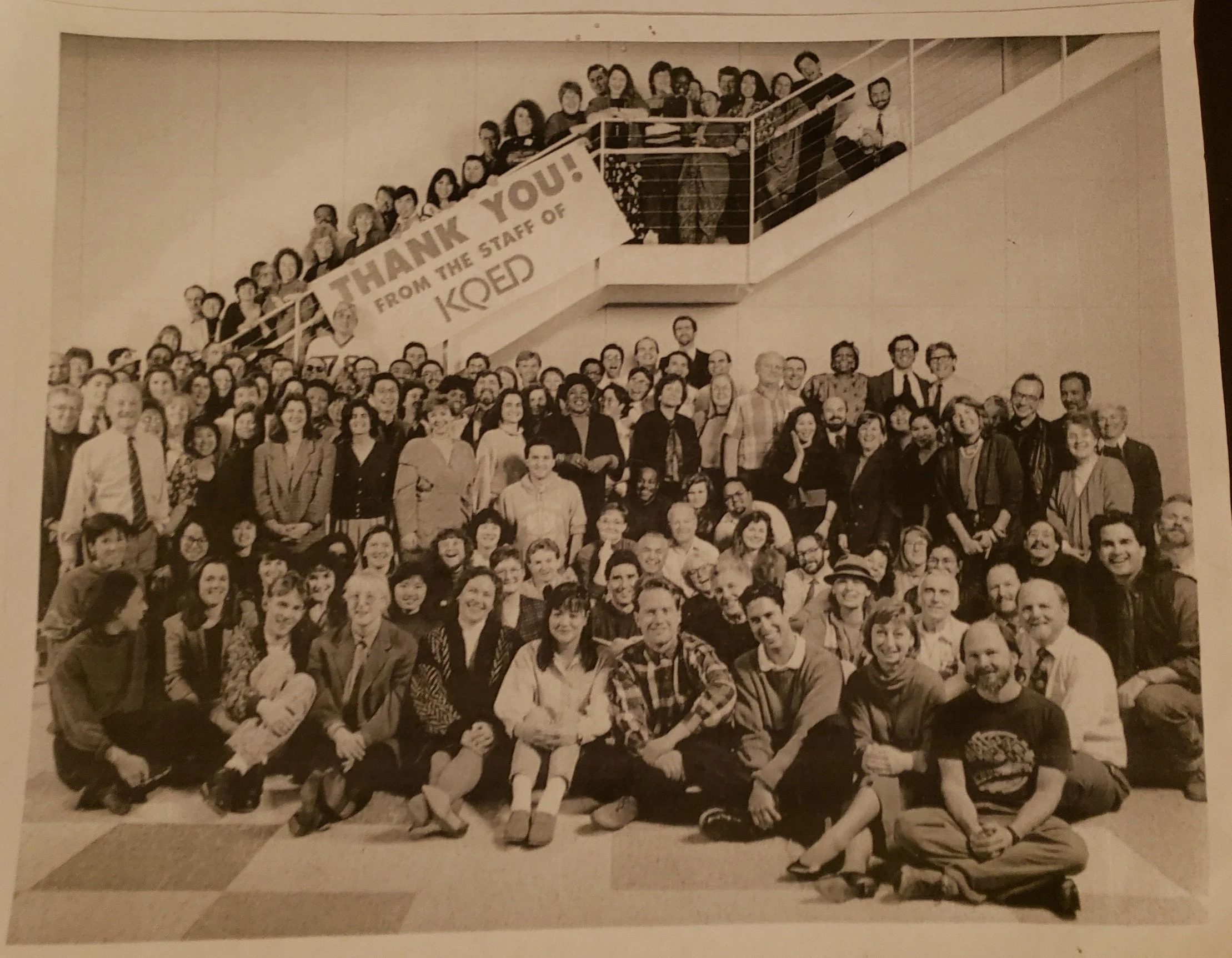
This photo of KQED staff was taken in the early 1990’s, just after KQED moved to it’s 2601 Mariposa Street location in San Francisco.
Staff Achievements
The photo includes many of my NATAS, Emmy and Peabody award-winning colleagues who like me, worked full time at the station, yet also volunteered their time to KQED projects and productions at night and on weekends.
This image is my personal copy, which was pinned to the wall of my KQED cubicle for many years.
KQED History Space
Apparently, the Campaign 21-remodeled KQED studios allegedly neglected to include a KQED History room to honor past employees, to display KQED staff and programming production awards, to view vintage television cameras and early sound equipment, to view award-winning past TV productions, or to display the artifacts and memorabilia of founders James Day and Jonathan Rice.
Let’s ask KQED to honor its past by creating a large KQED Museum area inhouse, to honor its award-winning founders, programming, talent and staff, plus their artifacts and history.
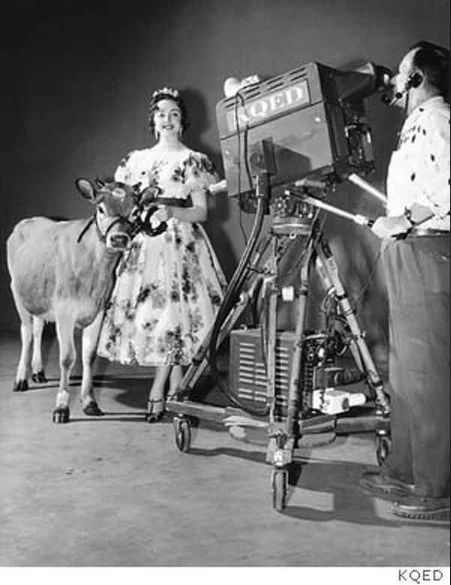
KQED has a great capacity to create television specials and documentaries about Bay Area life, culture and history, all produced inhouse, using KQED production staff.
KQED Founders Documentary
Ironically, KQED seems to have never produced a documentary about the life and legacy of its founders, James Day and Jonathan Rice. Let’s ask KQED to produce that documentary inhouse, to be broadcast on-air.
KQED History Documentary
Likewise, KQED, to my knowledge, has never produced a documentary about its own history, featuring highlights of its inhouse produced programming over the years, plus the lives of talent, production staff and the major donors who contributed to the station’s expansion and success since its inception as a PBS affiliate in 1953. Let’s ask KQED to produce a documentary on its own history, inhouse, to be broadcast on-air.
Bay Area Documentaries
1) Produce a documentary about the 1989 Loma Prieta Earthquake and the Earthquake Relief Concert: It’s Everybody’s Fault, the live “rock-a-thon” produced by KQED and Bill Graham. Excerpts of Graham, Bob Hope, station volunteers and musical performances during that three-stage televised event, should still be available in the KQED archives. (I write more about KQED and that fundraiser on my Silicon Valley Librarian Blog.)
2) Produce a documentary about the 1906 Earthquake, including the Panama-Pacific International Exposition of 1915 which was constructed near what is now Fort Mason Center. The City of San Francisco sought to host the 1915 PPIE to demonstrate that the City was now safe for tourism and business investments.
3) Produce a documentary on the IPA industry in the Bay Area.
4) Produce a documentary on the life of Bill Graham and the Filmore Auditorium, plus his work on many fundraisers, including Live Aid, as well as the many musical performers he introduced to Bay Area audiences.
5) Produce a documentary following the distinct stages of producing a television documentary at KQED studios, from program conception, pre-production, filming, editing and promotions, then on-air broadcast.
6) Produce a documentary on the plight of young working families and individuals in the Bay Area who face job insecurity from A.I. and the ongoing stream of downsizing companies, who can no longer afford to buy a home, pay off student loans or pay for child care.
7) Produce a documentary on the continued medical research occurring at UCSF, Stanford and other local educational and medical institutions, despite the loss of Federal funding.
8) Produce a series on the early history of Bay Area indigenous groups, their cultures and their status today.
9) Produce a series on the icons of Bay Area life and history: The Presidio, Fort Point, the Golden Gate Bridge, the Ferry Building, Alcatraz, the Sutro Tower, BART, Fisherman’s Wharf, Nob Hill and Pacific Heights, Lands End and the Sutro Baths, Sourdough, the Barbary Coast, San Francisco during the Gold Rush, Emperor Norton, Bummer and Lazarus, Bay Area Raptor migration, Fleet Week, Santacon, Moffatt Field, The New Almaden Mercury Mines and their importance during the Civil War, Jack London, John Steinbeck, Wallace Stegner and his activism, novels and famous students, on Herb Caen, plus Paul Draper and the 1976 Judgment of Paris, on the Ocean Shore Railroad, on the Old San Francisco Mint, on disappearing farms and farmland in Northern California, on Niles history, etc.
10) Produce a documentary on the California wine crisis, as low sales, young adults moving from wines to IPA, plus wildfires, water issues and the marijuana industry, all impact local wineries and vineyards.
11) Produce a series on the car culture in the Bay Area, including restoration modifications, classic cars, off road vehicles and trails, auto organized race events, etc.
12) Produce a documentary series on animation, video and recording studios in the Bay Area, plus their history and current projects.
13) Produce a “Made in the Bay Area” series about the many business and individuals who are producing quality, tangible local products.
14) Produce a documentary following young adults as they make difficult choices when aging out of Foster Care programs in the Bay Area.
15) Produce a documentary on the impact of ABAG on Bay Area cities.
16) Produce documentaries about first generation immigrant youth in the Bay Area from various cultures, plus the challenges they face while straddling old and new cultures.
Local Celebrities Impact On-Air Pledge Breaks
Finally, produce live, local inhouse Pledge Breaks around all PBS and KQED staff-produced television programming, using a broad range of talent and Celebrity age groups as Pledge presenters.
This will generate far more Pledge interest and enthusiasm with Bay Area audiences.
The current KQED use of generic, PBS-produced Pledge Breaks with canned PBS Pledge programming, along with the unfamiliar PBS Pledge hosts and presenters from only one older, East Coast age demographic, widely misses the mark for me.
As a former KQED employee and Bay Area native, I once experienced the clever and entertaining live Pledge Breaks featuring local Bay Area talent from various age groups, which were once broadcast live on-air on KQED radio and television.
Current KQED leadership, in my opinion, needs to understand that personal is powerful when it comes to fundraising. Using local celebrities from wide range of ages in Pledge pitches, builds far more depth and breadth in forming new and lasting connections with local audiences.
KQED could easily ramp up promotions and interest for live Pledge appearances of local Bay Area celebrities, weeks before the live, inhouse Pledge Breaks appear on-air.
Fundraising For Inhouse Broadcast Production
As proven by the success of Campaign 21, KQED is capable of making the effort to fundraise once again to fully support local programming productions like those above, which would make the station more personal, more engaged with a younger Bay Area demographic, plus more widely supported by its entire Bay Area on-air broadcast community.
Enhanced Underwriting Spots
KQED should be fully self-supporting, as befits a nonprofit broadcast entity which airs political and historic commentary with opinions which may not be shared with some viewers and listeners in its on-air community. Those who agree with the content aired will naturally support the station and that programming. That natural support will allow KQED to finally eliminate the overly-long videotaped donor and sponsor “enhanced underwriting spots”, which, lets face it, seem like commercials for those businesses. In my opinion, those detailed business spots seem in conflict with KQED’s noncommercial status.
Member Advocacy Dollars
Nat Katzman once made a comment that stuck with me, first as a TV Programming, then as a KQED FM employee. To paraphrase his comments, he alleged that if KQED were “offending” everyone in the Bay Area over the course of a week, then we were doing our job to report all sides of the issues.
Today it seems almost impossible to do ethical reporting without some unintentional, inherent bias. This occurs through selection of supporting facts while choosing sources, and in the selection of guest panelists for on-air history and news commentary.
Now completely donor supported after new Federal funding budget cuts, KQED allegedly depends solely on voluntary donor support. The loss of Federal funding no longer forces some taxpayers who may disagree with the commentary, programming and coverage provided by PBS and NPR stations, to fund content they don’t support. It’s now up to KQED leadership to provide new local educational and entertaining programming on-air, which most Bay Area residents will support.